
Coordinated by Lily Chen
1. Summary of the convening (Summarized by Elaine Want)
Edited Recording by Changfu White House AANHPI Lily and Elaine Remarks
(reference: Original recording by Elaine Wang: speeches by Lily & Elaine : White house speech clips)
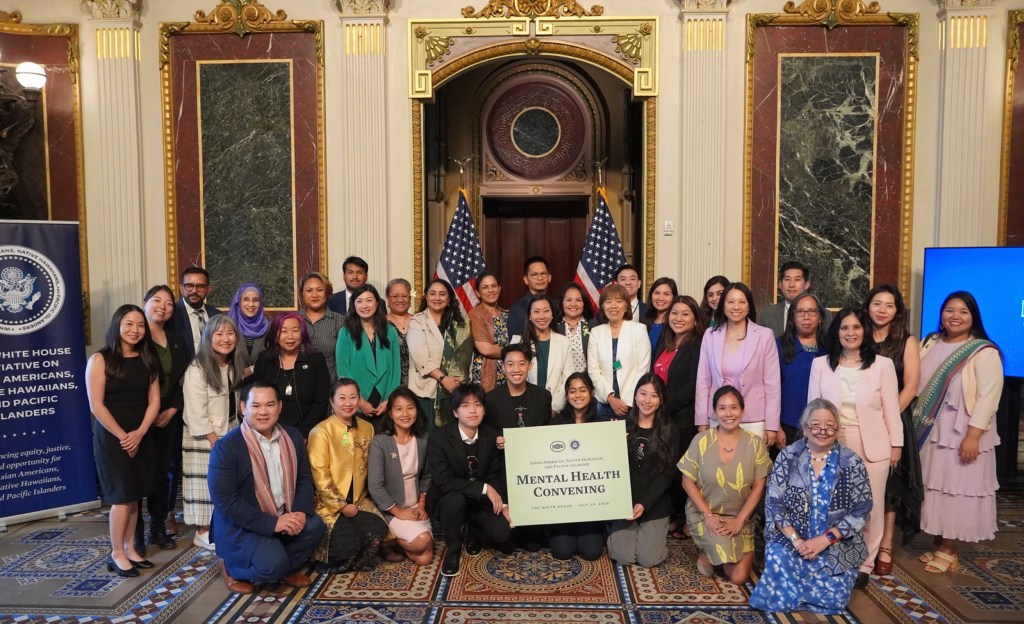
At the recent White House AA and NHPI Mental Health Convening, key representatives from the White House, Substance Abuse and Mental Health Health Service Administration (SAMHSA), US Health & Human Service Administration, alongside community leaders, convened to address the challenges faced by Asian Americans, Native Hawaiians, and Pacific Islanders (AANHPI) in accessing mental health care. The notable participants included:
● Erika Moritsugu, Deputy Assistant to the President, AA and NHPI Senior Liaison, White
House Chief of Staff
● Admiral Rachel L. Levine, MD, U.S. Assistant Secretary for Health
● Larke Huang, Director, Office of Behavioral Health Equity, Substance Abuse and Mental
Health Services Administration (SAMHSA)
● Krystal Ka‘ai, Executive Director, White House Initiative on Asian Americans, Native
Hawaiians, and Pacific Islanders (WHIAANHPI)
● Kota Mizutani – Senior Advisor for Public Engagement, White House Office of Public
Engagement
The convening covered several pivotal topics:
● Community strategies to counter AANHPI hate
● Access to the 988 mental health crisis hotline
● Data disaggregation and granularity to enhance comprehensive care
● Development of a behavioral health workforce tailored to AANHPI communities
● Language justice in the provision of mental health care
Following a discussion on local and federal measures to enhance access and reduce stigma, an invited panel of community leaders provided comments including Soha Mahapatra and Ethan Su from the youth organization AAPI Youth Rising. They delivered powerful remarks on the mental health challenges encountered by AANHPI youth. They mentioned how the model minority myth has the most negative impact on the mental health of AANHPI youth, who feel the pressure to outperform everyone else and power through their mental health challenges.
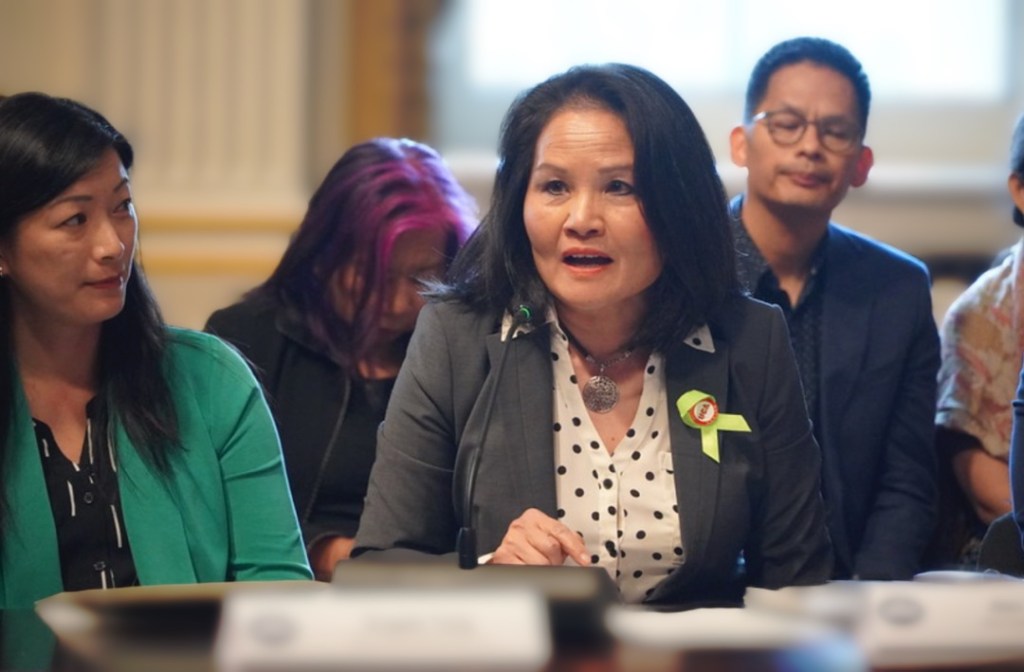
In response to their remarks, Lily Chen, Executive Director of the UCA WAVES Youth Mental Health Collaborative, highlighted the critical role parents play in facilitating youth access to mental health resources. She emphasized the significant barriers posed by the lack of training and knowledge about mental health, coupled with its stigma among the older generation of Chinese immigrants. She believes that removing those barriers by educating the parents would benefit the AANHPI youth tremendously. Lily also underscored the importance of including community’s voices in finding solutions – “Nothing About us Without Us” because communities are the closest to the problems therefore often can offer the best solution. Lily called for investing in building research capacity for community organizations, and shared examples of how UCA WAVES use their own research for building evidence surrounding community education and programs. Building research capacity is especially important for minority community based organizations like UCA WAVES.
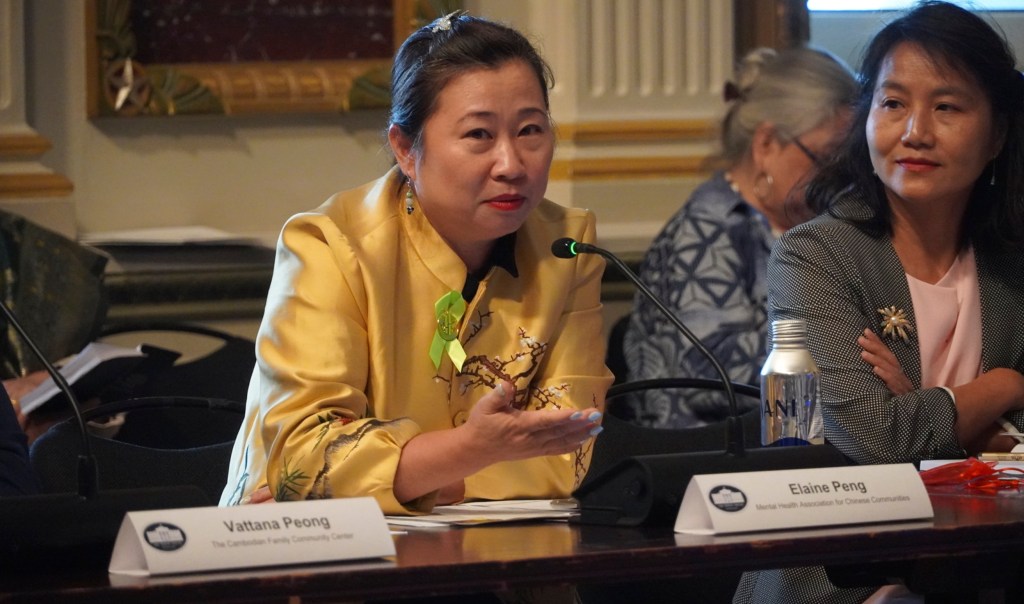
In addition, Elaine Peng, founder and executive director of the Mental Health Association for Chinese Communities (MHACC), used vivid examples illustrating the language barriers that hinder AANHPI individuals from obtaining timely and accessible mental health support and continuing treatment, and how her organization is dedicated to addressing these challenge yet severely underfunded. For example, their warm line service has been serving the community for 10 years, and only received $3,000 dollars from the California warm line organization.
The convening highlighted the importance of collaborative efforts between government agencies, community organizations, and individuals including youth in tackling the mental health challenges faced by the AANHPI community. By addressing barriers such as stigma, language, and access to care, we can work towards creating a more inclusive and supportive mental health care system for AANHPI individuals to decrease mental health disparity.
2、Zoom participant feedbacks from Justin Zhang
Justin Zhang: “I participated in the AANHPI Mental Health Convening at the White House the day before yesterday via Zoom, as well as the webinar hosted by SAMHSA and
NAAPIMHA yesterday. Asian Americans are often overlooked as a minority group in
many studies and policies. In recent years, the increasing hate crimes and
discrimination against Asians have posed a significant threat to our mental and
physical health. Yet, Asian Americans are among the least likely to seek mental health
support. Over the past few days, even in other WeChat groups, some Chinese people
have denied the severity of mental health issues faced by Asian Americans, using our
lower suicide rates compared to some other ethnic groups to downplay the
seriousness of our mental health problems. As a school counselor working in
Tennessee, I often see Asian American students feeling isolated or discriminated
against in my daily work. They often begin to have suicidal tendencies or even attempt
suicide before seeking help. This indicates that we need more public education,
advocacy, and research in mental health [GoForIt]. We need more detailed data, such
as how the mental health of Asian Americans compares to other ethnic groups in
similar socioeconomic situations, and what real mental challenges Asian American
youth face. This may help raise awareness among those who have not yet realized the
importance of mental health issues”
1, 会议总结 (Translated by Justin Zhang)
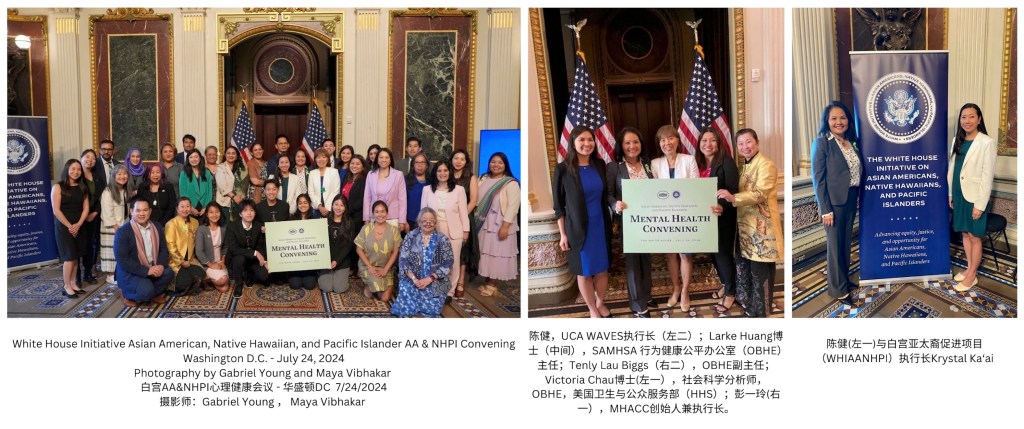
在最近的白宫亚裔及夏威夷原住民与太平洋岛民(AA和NHPI)心理健康会议上,白宫、药物滥用与精神健康服务管理局(SAMHSA)、美国卫生与人类服务管理局的重要代表,以及社区领袖们齐聚一堂,讨论解决亚裔美国人、夏威夷原住民和太平洋岛民在获取心理健康护理方面面临的挑战。重要的参与者包括:
Erika Moritsugu,白宫总统助理、AA和NHPI高级联络员、白宫办公厅幕僚长;
Admiral Rachel L. Levine,MD,美国卫生与人类服务助理部长;
Larke Huang,药物滥用与精神健康服务管理局(SAMHSA)行为健康公平办公室主任;Krystal Ka‘ai,白宫亚裔美国人、夏威夷原住民和太平洋岛民倡议执行董事;(WHIAANHPI)
Kota Mizutani,白宫公共参与办公室高级顾问。
这次会议涵盖了几个关键话题:
- 社区策略应对亚裔美国人、夏威夷原住民和太平洋岛民(AANHPI)的仇恨
- 获取988心理健康危机热线的途径
- 数据细分和精细化以增强全面护理
- 发展针对AANHPI社区定制的行为健康人力资源
- 在提供心理健康护理中的语言公正
在讨论地方和联邦措施以增强获取和减少社会污名后,一组社区领袖,包括AAPI Youth
Rising的Soha Mahapatra和Ethan Su,在邀请下提供了意见。他们对AANHPI青少年面临的心理健康挑战发表了有力的言论。他们提到,模范少数族裔的神话对AANHPI青少年的心理健康影响最为负面,他们感受到必须超越其他人并克服他们的心理健康挑战的压力。
作为对他们言论的回应,美国华人联盟UCA WAVES青少年心理健康合作计划的执行董事陈健强调了家长在帮助青少年获取心理健康资源中的关键作用。她强调了缺乏关于心理健康的培训和知识以及在老一代中国移民中的社会污名所带来的显著障碍。她认为,通过教育家长来消除这些障碍将极大地惠及AANHPI青少年。陈健还强调了包括社区声音在内寻找解决方案的重要性 – “没有我们的参与,就没有我们的事”,因为社区最接近问题,因此通常能提供最佳解决方案。陈健呼吁投资于建立社区组织的研究能力,并分享了UCA
WAVES如何利用自己的研究来支持社区教育和项目的例子。对于像UCA WAVES这样的少数社区组织来说,整合和建立研究能力尤为重要因为研究数据不仅是申请资源的重要因素,也确保指导服务及心理健康项目有效性以更好服务社区。
此外,彭一玲,美国华人健康联盟(MHACC)的创始人兼执行董事,通过生动的例子说明了语言障碍如何阻碍AANHPI个体及时获取和持续接受心理健康支持,以及她的组织如何致力于解决这些挑战尽管资金严重不足。例如,他们的温暖热线服务已服务社区10年,却只从加利福尼亚温暖热线组织获得了3000美元的资助。
此次会议突出了政府机构、社区组织以及包括青年在内的个人之间合作努力的重要性,以解决AANHPI社区面临的心理健康挑战。通过解决社会污名、语言障碍和获取医疗的障碍,我们可以努力创造一个更具包容性和支持性的心理健康护理体系,以减少AANHPI个体之间的心理健康差距。
2、线上会议参与者Justin Zhang的反馈
● Justin Zhang: “我通过Zoom参加了前天白宫的AANHPI Mental Health Convening以及昨天SAMHSA和NAAPIMHA举办的webinar。我们亚裔很多时候的确在很多研究和政策中都是被忽略的少数族裔。近年来针对亚裔的仇恨犯罪和歧视的增加,对我们华人的身心健康造成了巨大威胁。而我们亚裔同时又是寻求心理健康支持最少的族裔。包括这几天在其他微信群里,也有一些华人会去否认我们亚裔面临的心理健康问题的严重性,比如拿我们的自杀率没有一些其他族裔高来说明我们的心理健康问题不严重。作为一个在田纳西州工作的学校咨询师,我日常工作中经常看到我们的亚裔学生感受到被孤立,甚至被歧视。而且他们往往开始有自杀倾向了,甚至有自杀的尝试了之后才开始寻求帮助。这意味着我们在心理健康方面需要更多的科普,倡导以及研究[GoForIt] 我们需要更细致的数据,比如在社会经济地位类似的情况下,我们亚裔人口和其他族裔的心理健康相比如何,以及亚裔青少年真实遇到的心理挑战有哪些。这样可能更能帮助一些还没有意识到心理健康问题重要性的人提起重视。”
 UCA WAVES
Leave a comment